
Breaking the Plateau: Understanding the Pathway Between Effort and Outcomes
A plateau is often described as a period when progress stops.
That's a useful description of the result, but it doesn't tell us much about how we arrived there.
Consider two people pursuing the same objective. Both have experience, a reasonable plan, and the discipline to follow it. Both make progress initially. Eventually, their results level off.
On the surface, their situations appear similar.
But one may have reached the point where the demands of the plan exceed their ability to recover. The other may have adapted to those demands and now needs a different stimulus. Or the objective, available resources, and competing responsibilities may no longer align as well as they once did.
The outcome looks similar. The pathways are different.
And those differences matter when determining the appropriate next step.
Every Outcome Has a History
Every outcome reflects a series of influences.
Some are obvious: the work performed, the decisions made, the resources available, and the consistency of execution.
Others are less visible. Previous experiences, accumulated demands, changing capabilities, and the circumstances surrounding a person can influence how they respond.
That's why examining a plateau begins well before the moment progress appears to stop.
What was happening when progress was being made?
What conditions supported that progress?
What responses were observed along the way?
And what information might have been overlooked?
These questions aren't intended to find fault. They help establish a more complete picture of the pathway.
Understanding how a result developed gives us a better foundation for evaluating what it may require next.
Past Success Is Valuable Information
When an approach produces a desired result, we naturally develop confidence in it.
And we should.
Successful experience provides evidence that an approach can work under particular circumstances.
But it doesn't establish that the same approach will remain appropriate indefinitely.
Consider physical training. As strength, skill, and conditioning develop, the same training program may no longer present the challenge it once did. In other circumstances, accumulated demands may reduce a person's capacity to tolerate that program.
A 2026 American College of Sports Medicine position stand reviewed extensive resistance-training research and found that specific programming decisions influence particular physical outcomes. The evidence reinforces the importance of matching the training approach to the intended result and the individual performing it. [1]
The lesson isn't that every program must constantly change. It's that the approach should remain appropriate to the objective and the person performing it.
Outside athletics, the same principle offers a useful way to examine leadership, decision-making, and execution.
A system that served a smaller organization may become less effective as responsibilities expand. A personal routine that worked during one stage of life may become difficult to maintain under different circumstances.
These are practical parallels, not findings established by the resistance-training research.
The earlier approach wasn't necessarily wrong.
It may have been well suited to the conditions in which it succeeded.
Understanding why it worked helps us evaluate whether those conditions still apply.
Stimulus, Response, and Adaptation
One of the foundational models I've used throughout my coaching career is:
STIMULUS → RESPONSE → ADAPTATION
The model is simple. Applying it well requires considerably more understanding.
First, we learn to recognize the stimulus.
What is happening? What demands does the situation present? What information matters?
Recognition influences what happens next. Through instruction, repetition, and experience, we can improve our ability to identify familiar demands and respond appropriately, often with less hesitation.
The objective isn't simply to react faster. It's to recognize what matters sooner and make an appropriate response more readily available.
Then we examine the response.
Why did we respond that way? Was the response appropriate for the situation? Did it produce the intended result? What influenced our decision or execution?
These questions turn experience into information we can use.
Adaptation is the next consideration.
In physical training, appropriately managed demands and recovery can produce physiological changes that improve capacity. Adaptation is not guaranteed to be beneficial; the nature of the stimulus, the individual's condition, and the recovery available all matter.
In other environments, deliberate practice, feedback, and reflection can improve how we recognize situations, make decisions, and execute.
The mechanisms differ, but the practical objective remains:
Recognize the demand. Develop an appropriate response. Learn from the result. Become better prepared for the next encounter.
This applies whether we're preparing for competition, developing a skill, leading a meeting, evaluating a business decision, or working toward a personal objective.
It also helps us understand plateaus.
An approach that once produced the desired result may no longer be producing the same response. The demands may have changed. Our capabilities or circumstances may be different. Or we may have become highly practiced at a response that no longer serves the objective.
The value of the model isn't simply knowing that adaptation occurs. It's learning to examine the entire process so we can make better decisions about what to practice, what to change, and what to measure next.
Examining the Factors That Influence Performance
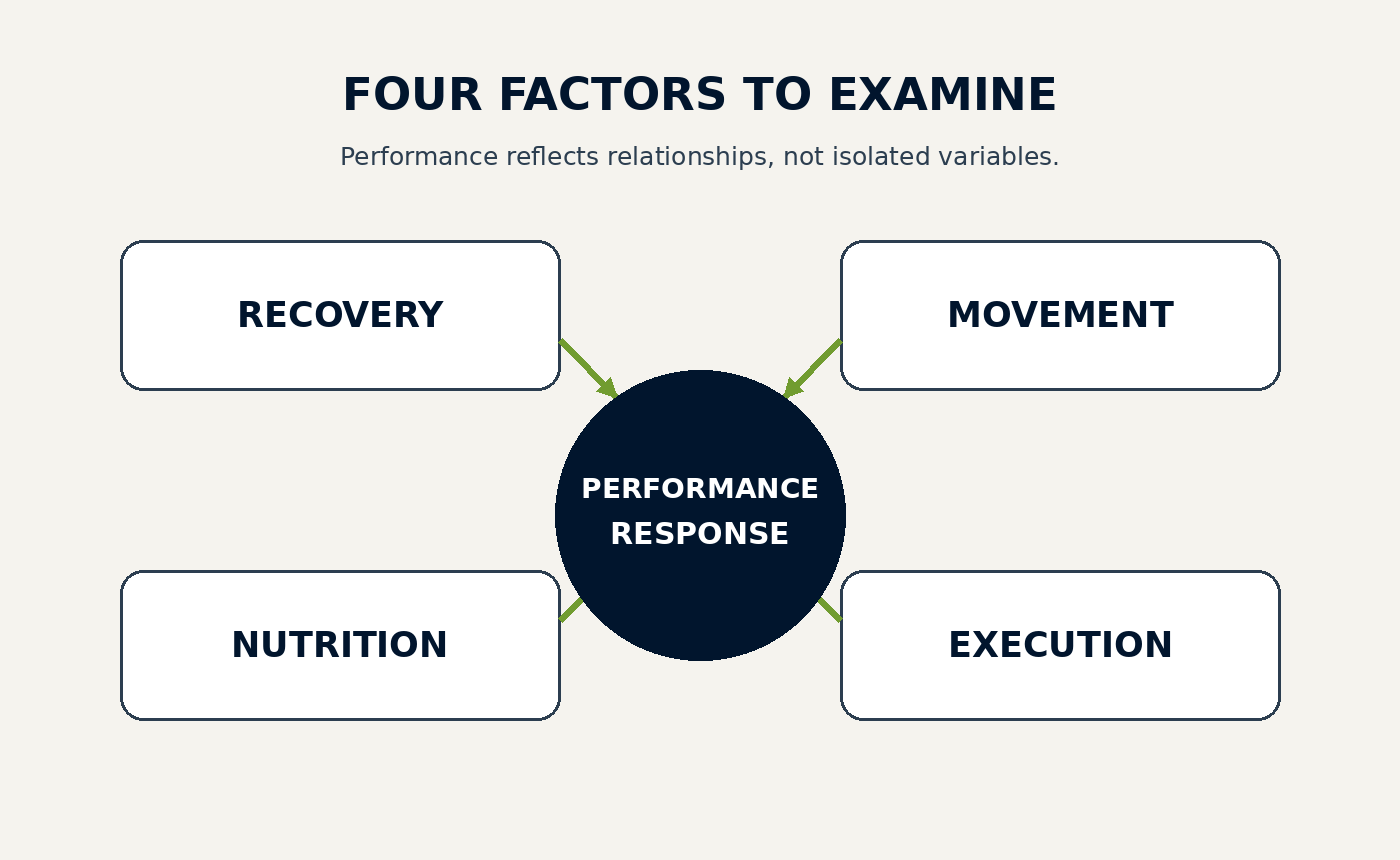
In performance work, four areas frequently deserve attention: recovery, movement, nutrition, and execution.
Each provides useful information. Their relationships can be even more revealing.
Recovery
Recovery influences our ability to respond to physical and psychological demands.
Sleep, accumulated workload, stress, and the spacing of demanding activities can affect readiness and adaptation.
A 2021 expert consensus published in the British Journal of Sports Medicine examined sleep and athletic performance, emphasizing that sleep needs and the factors affecting sleep vary among individuals. [2]
That distinction matters. Two people completing similar workloads may not have the same recovery needs or capacity.
Understanding the demands placed on someone is important. Understanding their response to those demands is equally important.
Movement
Strength, mobility, coordination, and movement efficiency affect physical capability.
But the objective determines which capabilities matter most.
The movement demands of competitive athletics differ from those of someone trying to maintain strength and function throughout daily life.
Training decisions should reflect those differences.
We also need to distinguish between performing an activity and developing the specific capability that activity requires.
Nutrition
Nutrition supplies the energy and nutrients required for normal physiological function, physical activity, and recovery.
Energy intake, dietary patterns, hydration, and individual health considerations can influence how someone responds to physical demands.
A nutritional approach that appears reasonable in isolation may be less appropriate when examined alongside training volume, recovery, health status, and daily responsibilities.
The value of examining nutrition isn't simply identifying what someone eats.
It's understanding whether their approach supports what they're asking their body to do.
Execution
Knowledge and capability don't automatically translate into consistent action.
A 2023 systematic review and meta-analysis examined the gap between intentions to be physically active and actual behavior. The findings demonstrate that intending to act does not necessarily translate into doing so. [3]
The study examined physical activity, not executive leadership or organizational performance. But it provides a useful foundation for considering the difference between developing an intention and consistently executing a behavior.
In practical terms, competing priorities, unclear expectations, unnecessary complexity, and limited support can make implementation difficult.
Sometimes the plan needs adjustment. Sometimes the opportunity lies in how the plan is executed.
Knowing the difference matters.
Where the Factors Intersect
Consider someone who has maintained a consistent exercise routine but is no longer making the expected progress.
Their immediate conclusion might be that the training program needs to become more demanding.
But examining the broader pathway may reveal several possibilities.
Their workload outside training may have increased. Sleep may have become less consistent. Nutritional intake may no longer match current demands. Or the training program may no longer provide the stimulus needed for the desired adaptation.
Each possibility suggests a different response.
And more than one may be contributing.
This is a hypothetical example, not a diagnosis. Its purpose is to illustrate why examining a single variable in isolation can lead to an incomplete interpretation.
The same reasoning applies when considering how people manage demanding schedules, develop new skills, or execute complex responsibilities.
Before deciding what to change, we need to understand what we're evaluating.
Learning From the Response
Once we understand the pathway, the next task is determining what deserves attention.
That requires distinguishing what we know from what we suspect.
We may have evidence that a particular adjustment is needed. We may have several plausible explanations. Or we may discover that important information is missing.
Each situation calls for a different decision.
Sometimes the appropriate next step is a small, measurable adjustment. Sometimes it's additional assessment, a change in expectations, or input from another qualified professional.
Whatever the decision, the response provides new information.
Did the adjustment produce the intended effect?
What improved?
What remained unchanged?
What did we learn that should influence the next decision?
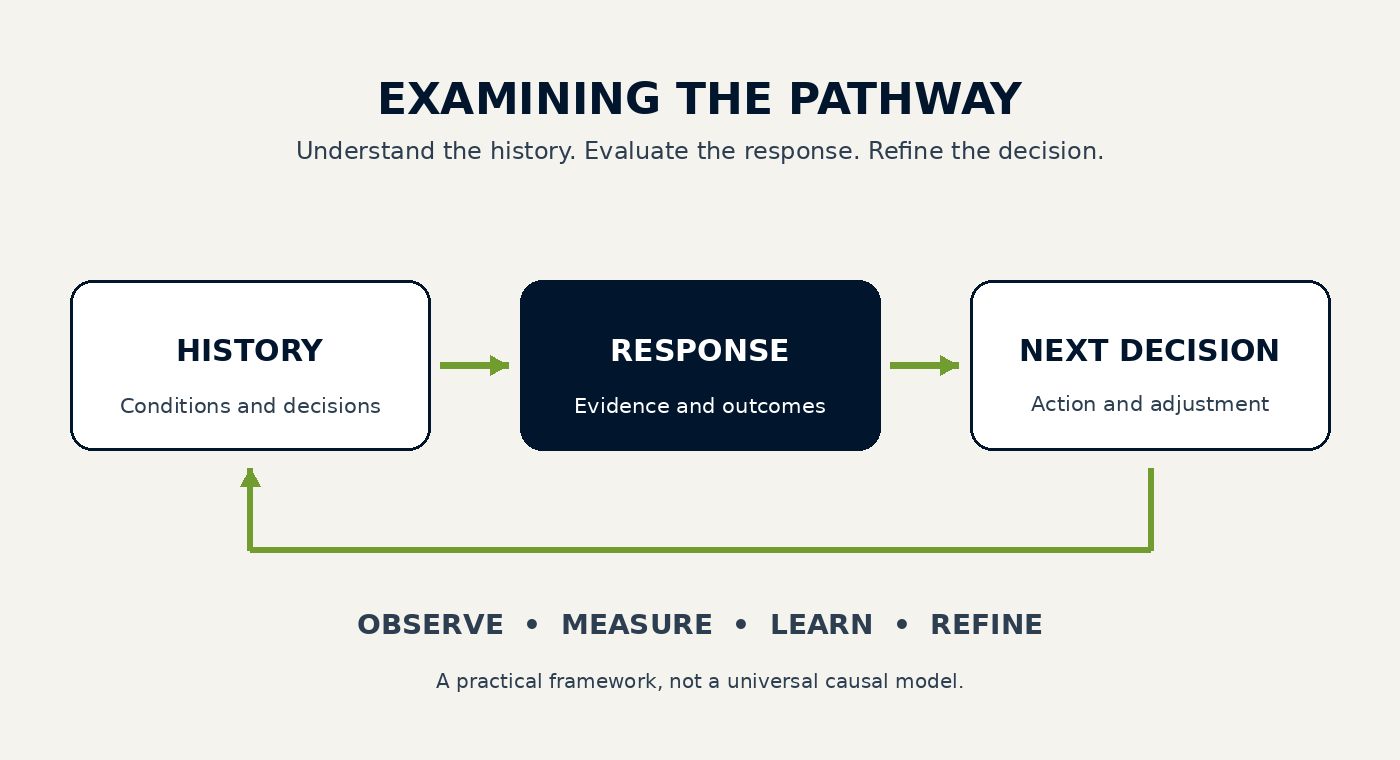
This is also where the stimulus–response–adaptation model becomes practical beyond a single encounter.
The information gained from one response can improve how we recognize, prepare for, and execute the next.
We develop the ability to observe, interpret, act, and refine.
Examine Your Own Pathway
If progress toward an objective has slowed, consider looking beyond the current result.
Begin with the period when things were going well.
What were you doing consistently? What resources and support were available? What demands were you managing? What evidence told you the approach was working?
Then examine the period leading to the plateau.
Look for differences in circumstances, capabilities, demands, expectations, and execution.
Consider the stimuli you've been encountering. Have they changed? Have your responses changed? Are those responses producing the improvements you intend?
You may identify something worth adjusting. You may also discover that the information available doesn't yet support a clear conclusion.
Both are useful findings.
The purpose isn't to produce an instant answer. It's to develop a more accurate understanding before deciding what to do.
A plateau doesn't erase the progress that preceded it.
That progress is part of the information available to you.
Assess what you have. Respect what has changed. Then find the next move.
Research & References
1. Resistance training and adaptation
Currier, B. S., et al. (2026). American College of Sports Medicine Position Stand: Resistance Training Prescription for Muscle Function, Hypertrophy, and Physical Performance in Healthy Adults—An Overview of Reviews. Medicine & Science in Sports & Exercise, 58(4), 851–872.
2. Sleep, recovery, and performance
Walsh, N. P., et al. (2021). Sleep and the athlete: Narrative review and 2021 expert consensus recommendations. British Journal of Sports Medicine, 55(7), 356–368.
Feil, K., Fritsch, J., & Rhodes, R. E. (2023). The intention–behaviour gap in physical activity: A systematic review and meta-analysis of the action control framework. British Journal of Sports Medicine, 57(19), 1265–1271.
Applying This Understanding to Your Circumstances
Sometimes examining your own pathway reveals a clear next step. With a better understanding of the demands, responses, and circumstances involved, you may be able to make and evaluate the necessary adjustments independently.
Other times, the relationships between those factors are difficult to evaluate from inside the situation. An outside perspective can help organize the information, challenge assumptions, and establish a practical direction.
The Total Human Performance Strategy Session is a private, 90-minute advisory conversation designed to examine your objectives, current circumstances, and the factors influencing your performance.
Together, we'll identify priorities and develop a practical direction. The engagement includes a personalized written Performance Blueprint and 14 days of follow-up email support.
Explore the Total Human Performance Strategy Session — $500
PDI performance advisory is not a substitute for medical evaluation, diagnosis, or treatment. Health-related decisions should be coordinated with qualified healthcare professionals.
Connect with The Peak Community
Join us for
The Peak Report
Ideas, research and practical thinking for human performance.
Your information will never be shared or sold